
Which Santa Cruz Records Are Open
Access depends on both the record and its keeper. California's Public Records Act applies to identifiable, nonexempt records held by state and local agencies. Court case files follow court rules instead, and certificates have their own eligibility rules. The table leads with the practical split: an online index may confirm that a record exists without displaying the record itself.
| Santa Cruz record set | Responsible custodian | Web coverage | Ways to obtain it |
|---|---|---|---|
| Deeds, liens, maps | County Recorder | Official Records index, 1978 to present | Free index; account download, counter, mail, email for maps, kiosk, microfilm, or Digital Reel |
| Superior Court cases | Superior Court Records Division | Cases opened after June 1985 | Portal, courthouse computer, microfiche, in-person or mailed copy request |
| Parcels and assessment | County Assessor and GIS | Current parcel information and map layers | APN or address lookup, GISWeb, report, office counter |
| Birth, death, marriage | Recorder, County Clerk, CDPH | No county public vital index found | Online order, lobby kiosk and counter, or mail application |
| City administrative files | Santa Cruz City Clerk | Records request page | Online, email, or hard-copy request |
| Custody and registries | County Sheriff, CDCR, California DOJ | Current local, state, and registry tools | Official web lookup, then direct agency verification |
Not every government file is open. Sealed cases, juvenile and adoption material, paternity matters, confidential voters, Safe at Home addresses, and protected identity fields stay limited. Recorded document images also remain off the public internet even though the index is searchable.
Lawful use. Use open records for lawful personal research, family history, property questions, and civic review. Never use names, addresses, or case data to stalk, threaten, harass, or harm anyone.
Santa Cruz Recorder's Split Archive
The County Recorder's search instructions describe three layers. The online Official Records index begins in 1978. The office has digitized records from 1850 to the present, but those images cannot be displayed on the public web. Images from 1850 through 1996 are available through microfilm and Digital Reel, while documents recorded before 1974 use handwritten index volumes at the Santa Cruz office.
The Recorder does not conduct a search for the requester. A visitor needs at least one party name and an approximate recording year. Viewing recorded documents and maps in the office is free. Copies can be downloaded after account registration, ordered by mail, or requested in person. A mail or counter order should give the document number, year, one party name, and document type. Map requests require the map book and page number and may also be sent by email.
Name forms changed over time. Index entries from 1974 through 1990 abbreviate the first word and later words. From 1990 through 1999, the first word is spelled out but later words can remain short. Since 2010, all words appear as written. Searches for a bank, trust, or other institution may need both full and abbreviated forms.
Note: The free web index is a finding aid, while the office, order system, and kiosks provide the record image or copy.
Recorder Index Search Fields
The Official Records Database Inquiry is precise about what it accepts. One of name, document title, or document ID supplies the search path, but every search needs a date range. The format and sort choices help separate people with similar names.
| Portal label | Input type | Required? | Format or choices |
|---|---|---|---|
| Name | Text | One search route | Last, First Middle Initial |
| Document Type/Title | Text | One search route | Document title words |
| Document ID | Text | One search route | Known document number |
| Date Range | Two dates | Yes | Month/Day/Year begin and end dates |
| Sort Order | Dropdown | No | Name, name type, document number, AP number, title, or date |
Result rows can contain a party name, document title and number, filing date, parcel number, and name type for relevant filings. Image access is a separate step. That distinction prevents a search result from being mistaken for a certified document.
- Index
- A list used to locate a record, not the complete filed image.
- Custodian
- The office responsible for keeping and releasing a record.
- Certified copy
- An official copy authenticated by the issuing office.
- Exemption
- A law that permits or requires an agency to withhold specific material.
Court Files Before 1985
The Santa Cruz Superior Court lookup searches a full or partial party name in Last, First format or a case number. It is not case sensitive. Cases opened after June 1985 can be found through the portal. Older searches need the Records Department or an in-person microfiche search. Without a case number, provide the party names and approximate filing year.
Public online documents are currently limited to civil cases. Restraining orders, probate files, family law records, and petitions involving a minor or disabled adult do not receive the same public web document access. The courthouse computer or Research and Copy Request Form is the fallback when more context is lawfully available. Current files may be seen the same day, but stored files need retrieval. Copies may be requested in person or by mail and can be held, mailed, or emailed, except certified copies cannot be emailed.
The Records Division charges $15 when a staff search exceeds ten minutes, $0.50 per copy page, and $40 to certify a document. Its standard turnaround can reach four weeks. Civil, probate, and appeals requests go to Room 110 at 701 Ocean Street; criminal and traffic requests go to Room 120. Family law and small claims also route by division and court location.
Santa Cruz Vital Record Copies
Certificates are requested rather than searched in an open county birth or death index. The Recorder holds Santa Cruz County births from 1905, deaths from 1873, and public marriages from 1851 when the regular license was issued in the county. Confidential marriage certificates belong with the County Clerk. Divorce records belong with Superior Court.
The Recorder's birth certificate page shows the authorized and informational copy choice, applicant details, record facts, eligibility boxes, and sworn statement. The image below captures that official application route.
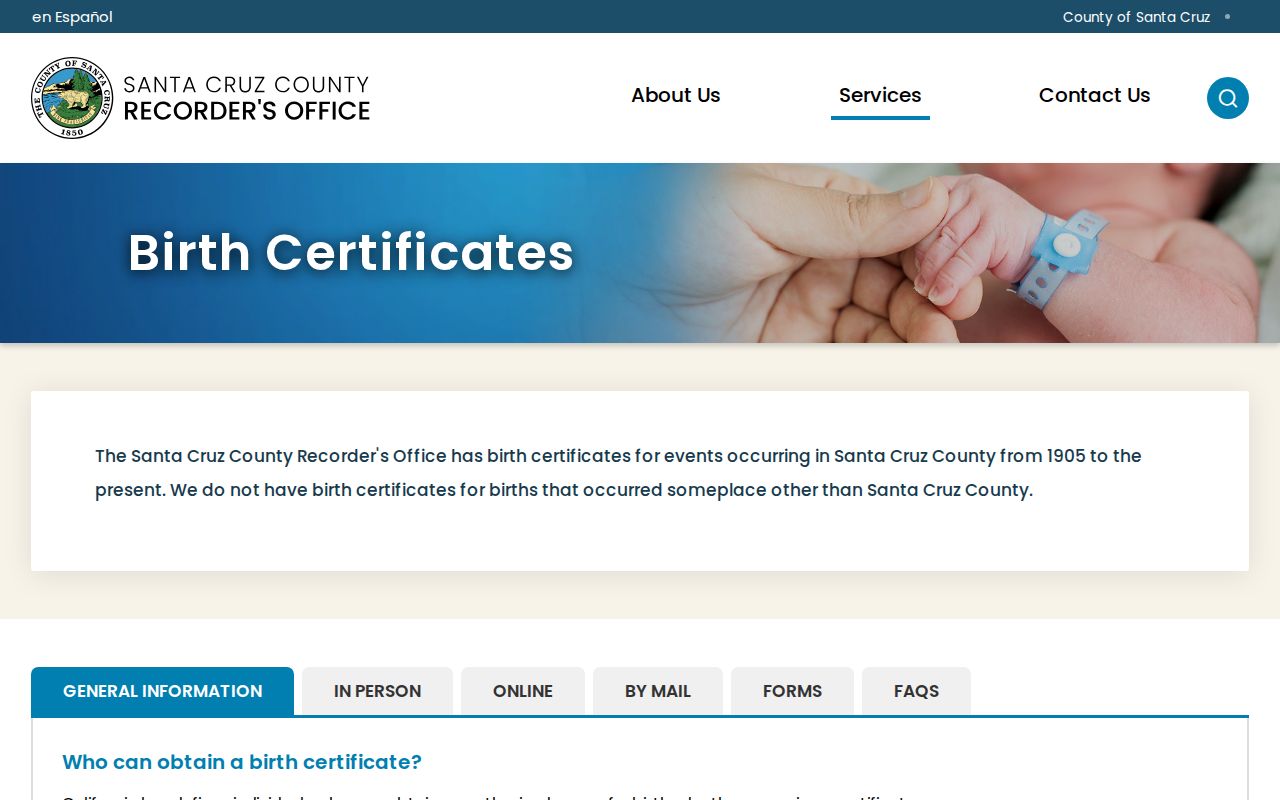
An authorized copy can establish identity and requires a qualifying relationship, legal role, court order, or official purpose under Health and Safety Code section 103526. Mail requests for authorized birth, death, or marriage copies need a notarized sworn statement. Other requesters may obtain a certified informational copy marked as not valid to establish identity. Orders are accepted online for mail or pickup, at lobby kiosks and the counter with photo ID where required, or by mail with check or money order. County fees are $34 for birth, $26 for death, and $19 for public marriage certificates.
Santa Cruz Property Record Layers
The County Assessor parcel search accepts either an assessor parcel number, called an APN, or a property address. Address searches omit suffix words such as Street or Boulevard. Results can lead to parcel lists, assessed value and taxes, addresses, parcel splits and combinations, transfers, and property characteristics.
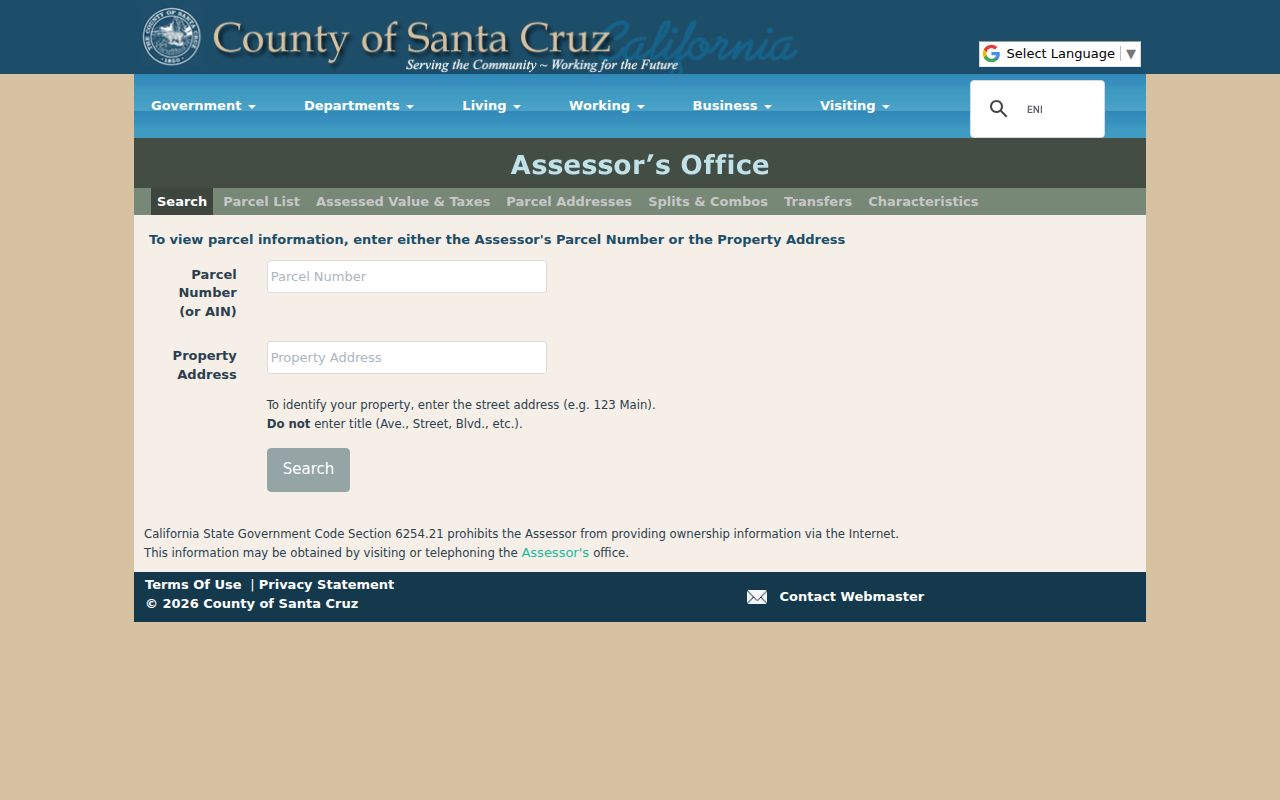
The assessor screen confirms the parcel identity route. The office identifies taxable property, ownership, and assessed value, but it does not issue the tax bill or collect the tax. Those functions belong to the Treasurer-Tax Collector.
The Santa Cruz County GISWeb viewer adds searches for APN, address, street, intersection, and owner. It can show property and zoning reports, recorded-document layers, jurisdiction and election areas, school districts, hazards, service areas, and other planning layers.
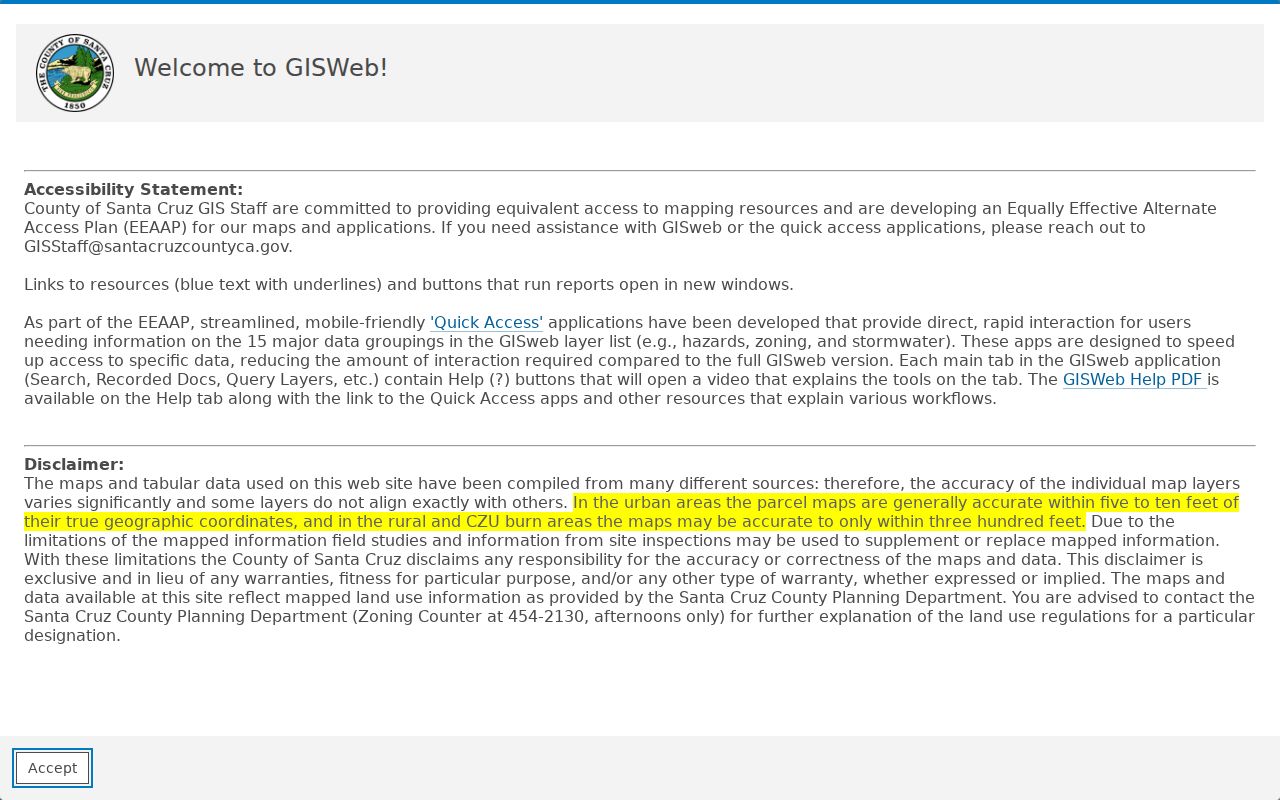
GISWeb is useful for finding the right jurisdiction before requesting permits. Its map is not a survey. County accuracy can vary from five to ten feet in urban areas to as much as three hundred feet in rural and CZU burn areas.
Permit records have their own time lines. The city eTRAKiT permit search uses APN, address, permit facts, and date filters, but pre-2010 files need staff research. The county's free parcel report covers permit history from 1985 forward. Older county activity goes through the Zoning counter or information line, and a changed APN can hide work filed under an earlier parcel number.
Public Map Access Moved Offline
A recent access change matters for parcel research. Since January 1, 2025, Government Code section 7928.205 has barred certain protected information from online posting. Because many recorded maps contain that information, the Recorder removed many map links from public web access.
The records are not simply gone. Public kiosks remain at the Recorder's Santa Cruz office in Room 230, the South County office at 500 Westridge Drive, and the Assessor's office in Room 130. Map copies still require a map book and page number. Requests may be made in person, by mail, or by email to the Recorder. The first map page costs $5, and each added page costs $2.
This web-to-kiosk shift is a clear example of the difference between public status and online display. A lawful record can remain available while its remote exposure is narrowed.
Note: Recorder map kiosks preserve in-person access even when privacy law prevents the same material from appearing on the open web.
Fees by Record Type
Copy costs depend on the issuing office and the form requested. Recorder copies of filed or recorded documents cost $1 per page, plus $3 per document for certification. Mail orders take a check or money order, while the counter also accepts cash. Vital orders placed through the online portal add a portal charge, identity verification charge for authorized copies, and card service fee.
City paper copies cost $0.25 per page. Superior Court copies cost $0.50 per page, with separate staff-search and certification charges. County parcel and GIS web lookups are free. The county's home-printed permit report is also free, while a Planning Department counter report costs $30. These amounts explain why the correct custodian and copy type should be clear before payment.
Custodians for Santa Cruz Records
The city is the county seat, so several major counters sit in the Ocean Street complex. Yet the office name still matters. The Recorder handles recorded documents and county certificates, the Assessor handles parcel identity, and Superior Court controls court files under its own access rules.
Santa Cruz County Recorder
701 Ocean Street, Room 230
Santa Cruz, CA 95060
831-454-2800
Official records and certificate services
Santa Cruz County Assessor
701 Ocean Street, Room 130
Santa Cruz, CA 95060
831-454-2002
Parcel and assessment records
Superior Court Records
701 Ocean Street, Rooms 110 and 120
Santa Cruz, CA 95060
831-420-2200
Case files and copy requests
Santa Cruz City Clerk
809 Center Street, Room 8
Santa Cruz, CA 95060
831-420-5030
City administrative records
Counter hours also differ. The Recorder's main office is open on weekdays from 8 a.m. to noon and 1 to 4 p.m. The Assessor is open on weekdays from 8 a.m. to 5 p.m. Confirm court division and location before seeking a file, since Santa Cruz and Watsonville handle different case types.
Santa Cruz Custody Record Channels
Local and state custody tools have separate scope. The Santa Cruz County Jail Viewer searches local bookings by last name, first name, booking-from date, and booking-to date. A percent sign works as a name wildcard. Results may show descriptive information, a mugshot, and charges, but current status should be confirmed with the jail.
The CDCR Inmate Locator covers state prison custody, not the county jail. California DOJ's Megan's Law search is the official public registry under Penal Code section 290.46. It is updated by law enforcement and exists for public safety. DOJ criminal-history summaries are not a public name lookup; a person may request their own record through the official fingerprint process.
Santa Cruz Records for Heir Research
Estate and heir research often crosses access systems. Probate files can name interested parties, wills, and representatives. Obituaries and death records can establish dates and family links. Recorded affidavits may connect an estate to land, while burial permits and older probate minutes can fill gaps left by modern portals.
The Santa Cruz Museum of Art and History preserves a county government collection from the 1850s to the present. It includes probate minutes, burial permits, court commitment papers, registrar records, and other people-bearing files. That archive is a lawful, human use for public material when family members are tracing an estate. Certificate eligibility and sealed-file rules still apply at each step.
File Santa Cruz Public Records Requests
The California Public Records Act, Government Code section 7920.000 and following, governs state and local agency records unless an exemption applies. Section 7922.530 requires agencies to make reasonably described, identifiable, nonexempt records available upon payment of direct duplication costs or a statutory fee. The ten-day period is a determination about responsive records, not a promise that every copy will arrive in ten days.
- Choose the custodian. Send deeds and certificates to the Recorder, court case records to the court, city business to the City Clerk, and other county department records through the county request system.
- Check the published access route. An index, parcel viewer, agenda archive, or courthouse terminal may answer the request without a broad filing.
- Describe the records. Give a date range, department, record type, keywords, known names, case or document numbers, and the preferred electronic or paper form.
- Submit by an accepted channel. The city accepts online, email, and hard-copy requests. County NextRequest metadata lists web, email, fax, phone, mail, and in-person channels.
- Review the response and cost. Ask the custodian to clarify an exemption, narrow a large request, or explain duplication charges before copies are produced.
The City Clerk request page asks for the details that help staff locate municipal files and states its ten-day determination practice.
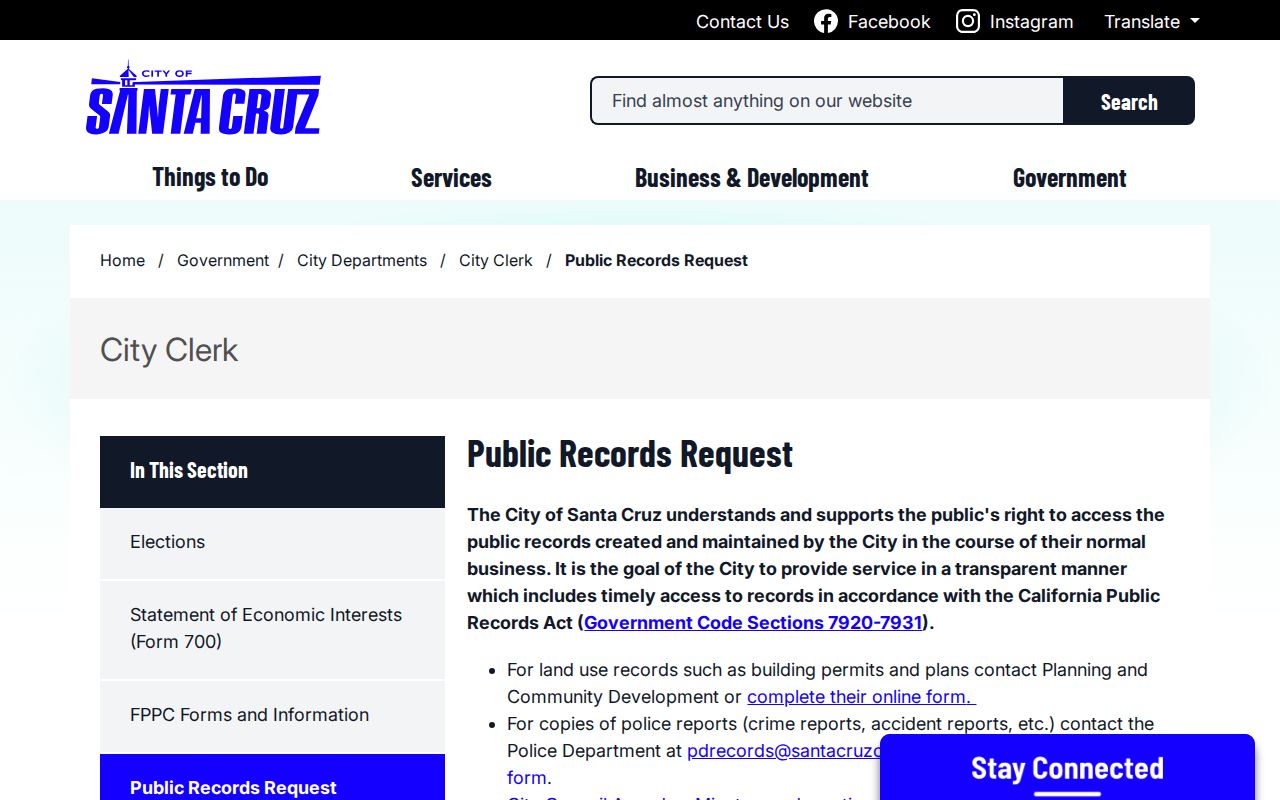
The city screen shows the direct municipal route. For county departmental files, the county NextRequest portal is the matching channel. Requests posted there are public, so sensitive personal information should not be placed in the request text. Vital certificates and recorded documents still go to the Recorder rather than the general county portal.