
Check Santa Cruz Voter Registration
The California Secretary of State My Voter Status tool is the first stop for a Santa Cruz resident checking their own voter registration. It is a private status check, not a directory that lets someone browse the county voter roll. Start with the voter's first name, last name, and date of birth. The current page is protected against automated inspection, so fields that appeared only in older official references should not be assumed to be part of today's form.
Enter the name as it appeared on the registration form and supply the requested birth information. Submit the check, then review the county and election details returned. If a recent registration update does not appear, use the county contact shown in the result or call the Santa Cruz County Clerk-Elections Department. The lookup can confirm a status, but it cannot furnish the complete voter file.
| Lookup entry | Control | Needed | How to use it |
|---|---|---|---|
| First name | Text | Yes | Confirmed in the official search-index capture. |
| Last name | Text | Yes | Confirmed in the official search-index capture. |
| Date of birth | Date or month selector | Yes | Official references identify birth information as required. |
| License, ID, or SSN4 | Text | Not confirmed | Older official references mention these items; the current interface was not verified. |
| County or ZIP | Dropdown or text | Not confirmed | The current input, if any, could not be inspected. |
The official My Voter Status screen shows the state service used for this personal check.
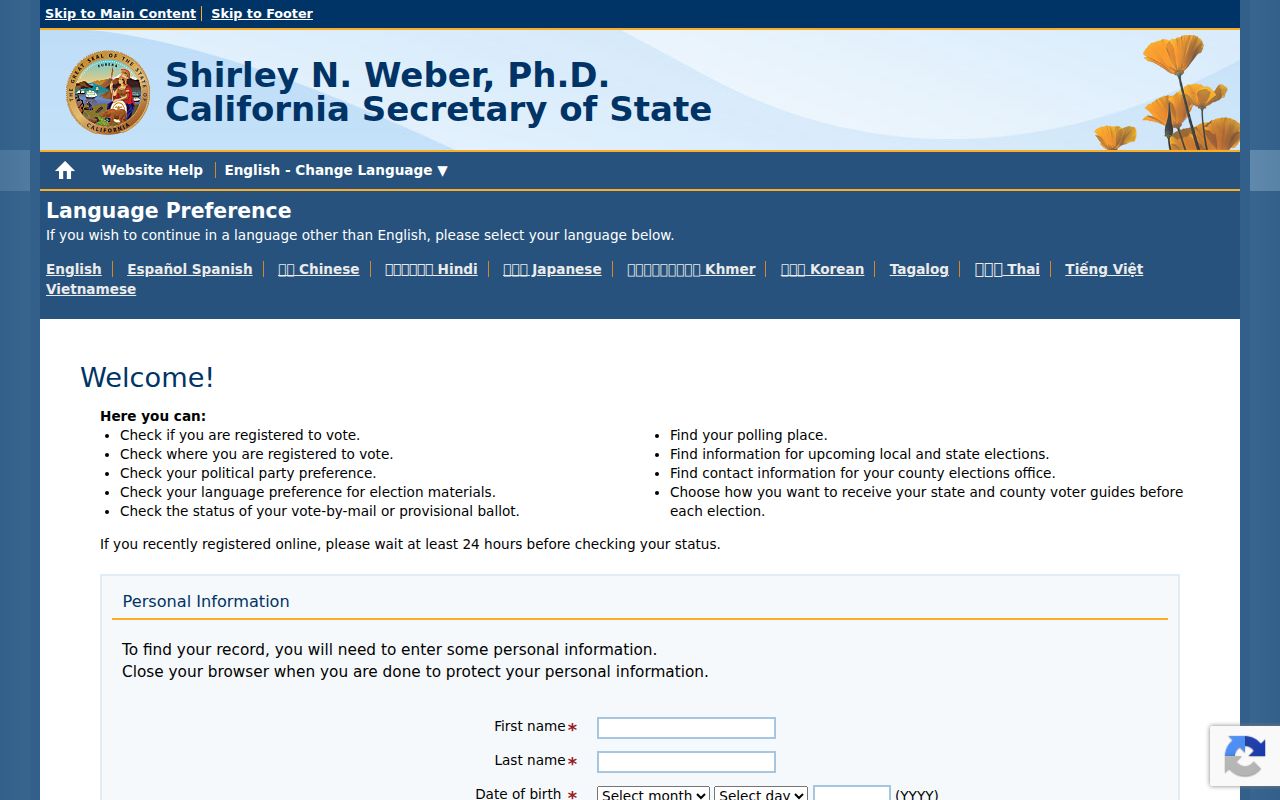
That screen marks the boundary between a voter checking personal election details and a qualified requester applying for voter records through an elections office.
Santa Cruz Lookup Results
A successful status check may return where the person is registered, political party preference, language preference for election materials, and the status of a vote-by-mail or provisional ballot. It may also show the polling place, upcoming local and state election information, the county elections office contact, and the selected way to receive state and county voter guides.
These are personal election-service results. They should not be confused with the fields released in an approved voter file. A person who needs to correct a record, confirm a ballot status, or resolve an apparent mismatch should contact Santa Cruz County Elections rather than trying alternate identities in the self-lookup.
Note: My Voter Status confirms personal election details; it does not provide a public name-by-name search of Santa Cruz voter rolls.
Fields in California Voter Records
An approved California voter registration data file carries far more detail than the self-lookup. The standard data file is always part of an approved delivery. Participation history and political district data are separate components that must be requested. Active voter records are included automatically, while inactive voter records must be selected on the application.
| Voter name | Released to a qualified requester. |
|---|---|
| Date of birth | Included in the approved state data file. |
| Registration date | Shows when the registration was recorded. |
| Addresses | Residential and mailing addresses are included unless the voter is confidential. |
| Precinct | Connects the voter to a local election precinct. |
| Contact information | Released when included and not protected by a confidentiality rule. |
| Party preference | Shows the political party preference on the registration. |
| Voter status | Active records are automatic; inactive records require a request. |
| Participation | Optional file with election date, election type, and voting method. |
| District data | Optional file linking precinct and district numbers and types. |
The state supplies approved voter-file data as three tab-delimited text files: the registration data file, the optional participation history file, and the optional political districts file. A tab-delimited file is plain text whose fields are separated by tab characters, so database or spreadsheet software can import the rows.
Confidential Santa Cruz Voter Records
California draws a firm line around sensitive data. Elections Code section 2194(b) excludes a driver's license number, California identification card number, the last four Social Security number digits, a unique identifier, and a signature or digitized signature image from voter registration information files. Pre-registration records for 16- and 17-year-olds are also withheld because those minors are not registered voters until age 18.
Confidential by California law. Records protected under Elections Code sections 2166, 2166.5, 2166.7, and 2166.8 are not supplied to voter-file requesters, and section 2194(b) bars release of core identity numbers and signatures.
The California Safe at Home program provides a substitute mailing address that public agencies accept in place of a residential or other mailing address. It began in part to keep address and voter records confidential for people at risk. Eligible groups include survivors of domestic violence, sexual assault, stalking, human trafficking, and other harms listed by the Secretary of State.
Requesting Santa Cruz Voter Files
Access is limited by purpose. California allows candidates for office, qualifying initiative or referendum committees, and people seeking data for election, scholarly, journalistic, political, or governmental purposes to apply, subject to the statutory conditions. The Secretary of State decides whether a state application is complete and whether the proposed use is permitted. Confidential records remain excluded even after approval.
- Choose a statewide file, a single-voter request for up to ten named voters, or a Santa Cruz County file from the county elections official.
- State an authorized purpose and select any optional participation history, district data, or inactive voter records needed.
- For a state request, include the original signature, a clear copy of current state identification, supporting documents, and the fee. Mail or hand-deliver it because email and fax are not accepted.
- For a county file, submit the written request in person with identification and pay the applicable county product fee in advance.
The Secretary of State voter-file page publishes the state request rules and cites Elections Code sections 2188 and 2194. The Santa Cruz County application records the local choices, declaration, and security terms. State requests generally take 7 to 14 business days after receipt and review. County orders are normally completed within two working days, apart from daily vote-by-mail voter information requests.
Santa Cruz County Request Desk
The Santa Cruz County voter-file process requires each request to view, buy, or use voter registration information to be made in writing, submitted in person, and accompanied by identification. The application asks for requester details, the stated purpose, the data product, optional history or district data, and an acknowledgment of the use and security rules.
The local custodian is the Santa Cruz County Clerk-Elections Department at 701 Ocean Street, Room 310, Santa Cruz, CA 95060. The desk is open Monday through Friday, 8:00 a.m. to 5:00 p.m., including lunch. Call 831-454-2060 or 866-282-5900, email info@votescount.santacruzcountyca.gov, or use 711 for TDD/TTY service.
The county voter-file request page shows the local application route and its in-person requirement.
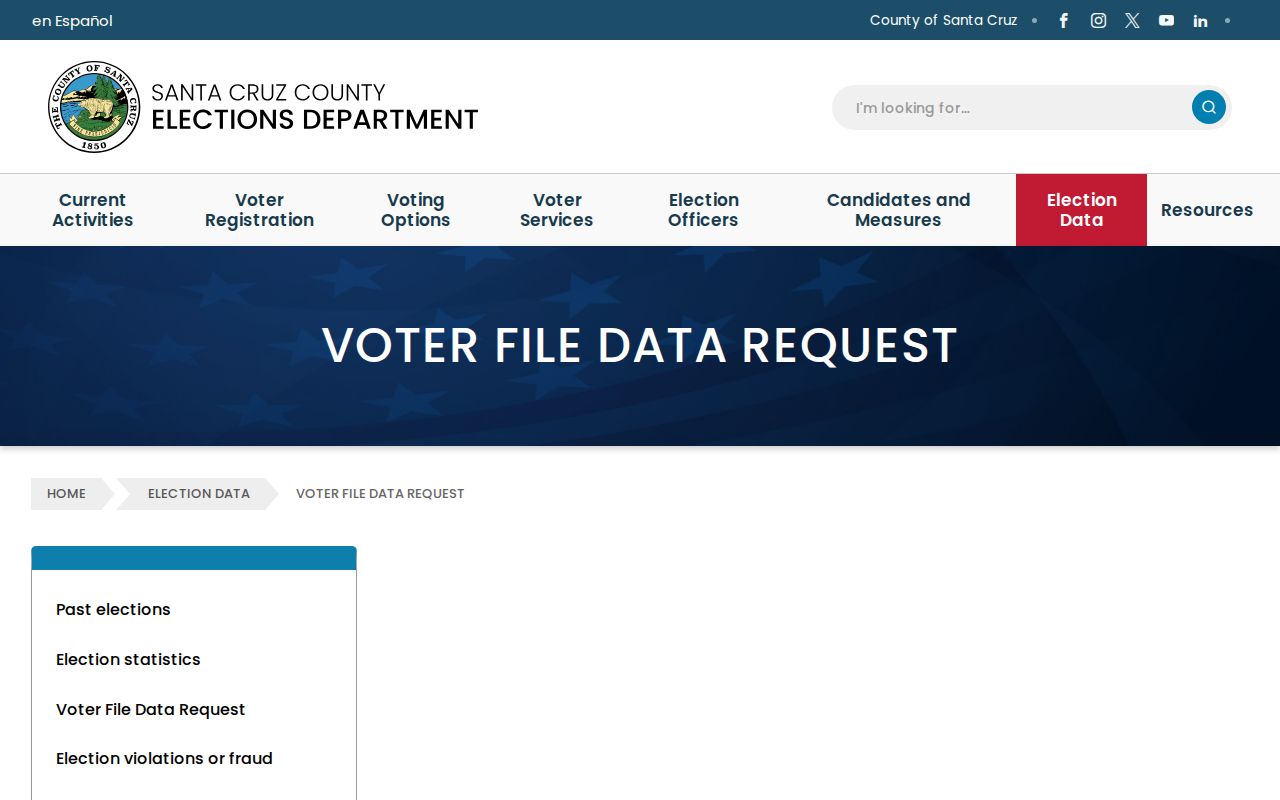
This county channel is the direct route for Santa Cruz-only voter rolls, while the Secretary of State handles statewide and specified single-voter applications.
California and County File Costs
Cost depends on the request scope and delivery product. A county-specific file has local pricing, while the Secretary of State uses a statewide data formula. Confirm the product before paying because participation history, districts, inactive voters, street order, and election timing can affect what must be selected.
| Voter data product | Price or schedule | Key condition |
|---|---|---|
| Statewide voter file | $15 per 1,000 records; $15 minimum and $100 maximum | Qualified state requester |
| Single-voter state record | $30 per voter; $100 maximum | Up to 10 voters per application |
| County walking list | $0.50 per 1,000 names | By consolidated voting precinct at stated pre-election points |
| Printed county index | $50 to $150 | Price rises across the county's three name-count bands |
| County CD or custom order | $50 to $150 | Based on record count; voter history may be added |
Printed voter indexes may be ordered by street, alphabetically, or as a custom order. County CD products may include vote-by-mail voters and optional voter history. Payment is due in advance.
Note: A county file price is not the statewide fee; select the office and scope before preparing a Santa Cruz voter records request.
Voter History Is Not Choices
Participation history is often misunderstood. An approved optional history file can show the type and date of an election and the method used, such as polling place, conditional registration, or vote by mail. It never reveals how the voter marked a ballot. Ballot selections remain secret.
The difference matters when reading Santa Cruz voter records. A participation entry documents that a voting event took place through a named method, not support for a person, party, or measure. The optional political districts file is also distinct. It links precincts to district numbers and types rather than reporting personal choices.
Limits on Santa Cruz Voter Data
Approved voter data may be used only for the purpose stated and allowed under California law. It may not be transferred, sold, or repurposed outside those limits. The Secretary of State points applicants to Elections Code section 18109(b), Business and Professions Code section 17538.41, Government Code section 7924.000, and the voter-access regulations in California Code of Regulations sections 19001 through 19013.
Use voter records lawfully. Do not use registration data to stalk, threaten, harass, or harm anyone. Misuse can lead to statutory penalties, and an approval does not override confidentiality protections.
Questions about a proposed state use go to the VoteCal Help Desk at 916-654-1141 or votecalhelp@sos.ca.gov. Suspected county-file misuse should be raised with Santa Cruz County Elections. General access-law questions belong on the Santa Cruz public records route, but voter files remain governed by their own election statutes and regulations.
Santa Cruz Registration Snapshot
The Secretary of State's 15-day registration report for the June 2, 2026 Primary, dated May 18, counted 195,800 eligible voters and 173,653 registered voters in Santa Cruz County. The largest listed groups were 101,492 Democratic registrants, 34,194 voters with no party preference, and 25,111 Republican registrants. Smaller party and other categories made up the balance.
These totals are a dated county snapshot, not a live voter registration lookup. The county's official election statistics later used 173,398 registered voters and reported 87,340 ballots, or 50.37 percent turnout. Changes between official reports can reflect the date and purpose of each count, so cite the report date with any statistic.
Historical Santa Cruz Voter Registers
Modern voter-file rules are not the only way to study Santa Cruz electoral history. Santa Cruz Public Libraries lists a revised transcription of the county's 1890 Great Register. Its microfilm and local-source holdings also identify Great Registers spanning 1900 through 1944. These named historical registers can help with genealogy, former-resident research, and the study of old communities.
FamilySearch catalog information identifies Santa Cruz County Great Registers for scattered years from 1868 through 1898, arranged by the first letter of surname and filmed from originals held by the California State Library. The MAH Government Records Collection also preserves county registrar records among government materials dating from the 1850s forward. No specific official poll-book series was confirmed, so researchers should ask for Great Registers or registrar records instead of assuming poll books exist.
Historical access is an archive and library task. It does not bypass current confidentiality rules or turn today's voter database into a genealogy directory.